
In the world of open-source intelligence (OSINT), there is a persistent and dangerous misunderstanding: the conflation of data with intelligence.
Most engineers build scrapers and call them intelligence tools. Most analysts buy access to databases and call them intelligence platforms. But data is simply raw material—often messy, usually untrusted, and always voluminous. Intelligence is something else entirely. Intelligence is the result of a rigorous, repeatable process that transforms that raw material into a signal that can be used to make high-stakes decisions.
To build an “Intelligence Core” at scale, you cannot simply be an engineer who knows how to use Puppeteer. You must be a systems architect who understands the physics of information propagation, the economics of evidence, and the brutal reality of system entropy.
This essay outlines the canonical architecture of a high-fidelity Intelligence Core, the same operating model behind systems like TraxinteL. It is also the connective tissue across my collection and orchestration, correlation and scoring, and evidence and forensics work.
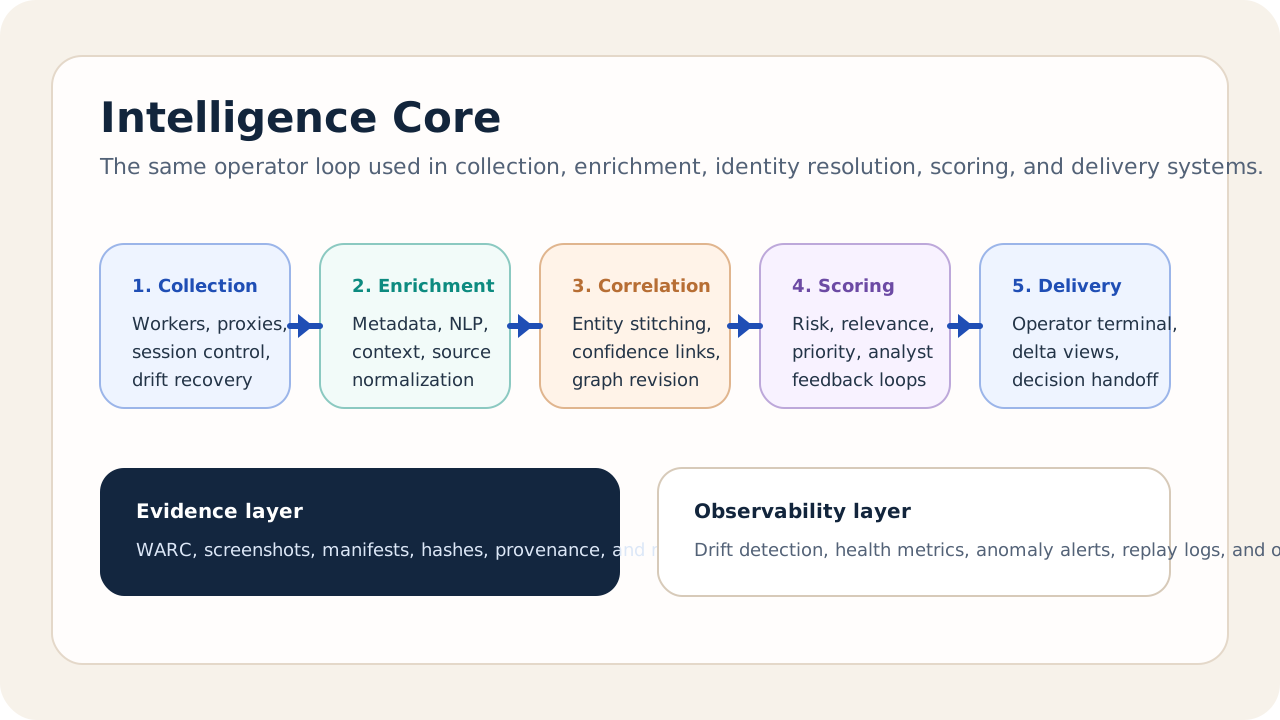
1. The Canonical Pipeline: A Higher-Order View
An Intelligence Core is not a single application; it is a series of stateful transitions. Every piece of data that enters the system must undergo a specific set of transformations before it can be trusted.
Phase A: Collection (The Sensory Layer)
Collection is the most visible part of the system and, ironically, the most frequently misconfigured. A naïve collector fetches a URL. A professional sensor orchestrates a behavior.
At scale, collection becomes a distributed systems problem. You aren’t just “requesting data”; you are managing a fleet of workers, a pool of rotating proxies, and an ever-evolving set of anti-detection configurations. If your collection layer is built on static scripts, it will decay. If it is built on a programmable runtime (like the systems used in TraxinteL or WingAgent), it can adapt.
Phase B: Enrichment (The Contextual Layer)
Raw data is useless without context. If you capture a username on an obscure forum, that data point has a value of exactly zero. It only becomes valuable when it is enriched with metadata: Who else used this name? What time was the post made? What other identifiers (emails, IPs, behavioral footprints) are associated with it?
Enrichment is where you apply NLP pipelines for entity extraction, sentiment analysis for narrative tracking, and geolocation services to ground the digital in the physical.
Phase C: Correlation & Entity Resolution (The Linking Layer)
This is the “hard” part of intelligence engineering. How do you know that @User123 on X is the same person as User123 on a dark-web marketplace?
Deterministic keys (like email addresses) are rare. Most correlation is probabilistic. You are scoring the likelihood of identity based on a “soft” stack of signals: writing style, activity cadence, common associations, and recycled assets. Designing this layer requires moving away from the “One True Identifier” model and toward a graph-based identity model where every link has a confidence score.
Phase D: Scoring & Evaluation (The Analytical Layer)
Not all signals are equal. A threat signal from a verified source in a high-risk region is more important than a noise-signal from a bot account. The Intelligence Core must apply a scoring layer that filters the information for relevance, risk, and urgency.
Phase E: Delivery (The Presentation Layer)
The final transition is from the system to the human. Intelligence that sits in a database is dead. It must be delivered via an operator-grade terminal that highlights the “Delta”—the thing that changed, the thing that matters, the thing that requires a decision.
Representative operator flow
In a representative due-diligence workflow, a single trigger can fan out across the whole core:
- A collection worker captures a new mention of an alias on a forum that was previously yielding no signal.
- The enrichment layer adds posting time, neighboring handles, reused avatars, language markers, and the source’s trust profile.
- The correlation layer links that alias to an existing entity graph with a confidence score instead of a hard identity claim.
- The scoring layer promotes the record because the alias already appears in a monitored watchlist and the new source is both recent and high-friction.
- The delivery layer shows the analyst the delta, the evidence chain, and the reasons the match moved from “possible” to “actionable.”
That is what “turning noise into signal” looks like in practice. It is not a crawler output. It is a defensible operator workflow.
2. Failure Modes: Silent vs. Loud
In standard web engineering, failure is usually loud. A server returns a 500. A frontend throws an exception. In intelligence engineering, the most dangerous failures are silent.
The Drift Failure
Your scraper continues to work, but the target site has silently changed its layout. You are still collecting data, but the “Email” field is now capturing “Followers Count.” Your system doesn’t error out, but your intelligence product is now contaminated with garbage.
The Bias Failure
If your entity resolution logic is too aggressive, it starts merging distinct people into single “Super-Identities.” You have successfully correlated data, but you have created a lie. If your analysts don’t have a way to audit the “Why” behind a merge, the system has failed.
The Evidence Decay
Digital artifacts are ephemeral. If your system records that a post existed but doesn’t capture a serialized immutable snapshot (with signed metadata), that intelligence is useless for legal or forensic purposes six months later when the post is deleted.
3. Evidence Engineering: Trust as a Technical Constraint
In an Intelligence Core, “Evidence” is a first-class citizen. Every conclusion the system reaches must be traceable back to its origin.
We solve this through Evidence Engineering.
Corroboration note. The preservation model here is not theoretical. It tracks directly with how formal evidence handling is described in NIST SP 800-86, how replayable web captures are packaged in the WARC guidelines, and how immutable retention is implemented through WORM-style object locking.
- Immutable Snapshots: We don’t just save text; we save the raw WARC file, the rendered PDF, and the cryptographically hashed screenshot.
- Traceability: Every record in our OpenSearch cluster must have an
origin_idthat links back to the specific worker session that captured it. - Auditability: If an analyst asks, “Why did we correlate these two accounts?”, the system must be able to surface the “Linking Evidence Chain”—the exact sequence of soft signals that triggered the identification.
4. Designing for Revision, Not Certainty
The fatal flaw in many intelligence systems is the assumption that data is truth. It isn’t. Data is a snapshot of a moment in time, often intentionally obfuscated by an adversary.
Therefore, the Intelligence Core must be designed for Revision.
- Temporal Versioning: Every entity record must be versioned. If we learn new information today that contradicts what we knew yesterday, the system shouldn’t just overwrite; it should create a new temporal state and preserve the history of our “Intelligence Evolution.”
- Confidence Calibration: Every link and every score must be dynamic. As we ingest more signal, the confidence scores in our identity graph must be recalculated.
5. Summary: The Mindset of the Operator
Building an Intelligence Core is a continuous exercise in humility. You are building a system that attempts to map a chaotic, adversarial, and shifting digital landscape into a structured model.
The best systems are the ones that acknowledge their own limitations. They are built for idempotency (can I run this again and get the same result?), traceability (where did this come from?), and resilience (will this survive the proxy pool collapsing at 3 AM?).
As you move through the rest of this Roadmap, keep the pipeline in mind. Whether we are discussing “Browser Telemetry Evasion” or “Hybrid Search Infrastructures,” we are always talking about the same thing: The rigorous technical orchestration required to turn noise into signal.
This is what it means to ship systems. This is the work of the Intelligence Core.