Correlation and scoring
Entity resolution, de-duplication, ranking, and confidence models for turning noisy signals into usable intelligence.
I build the decision layers that sit between raw data and operator action: identity resolution, ranking, confidence scoring, and the logic that makes output defensible.
Who it is for
- Teams trying to reduce duplicate noise and fragmented identity records.
- Products that need ranking, prioritization, and evidence-aware retrieval.
- Operators who need better confidence signals before they trust an output.
What changes
- Higher-quality results from the same raw input volume.
- Better prioritization for analysts and clearer confidence signals.
- A retrieval layer that balances exact identifiers with contextual relevance.
What you get
- Entity resolution models and identity stitching workflows.
- Ranking and scoring systems tied to operator feedback loops.
- Evaluation paths for relevance, confidence, and result quality.
Where I have done this
TraxinteL 2024–present A digital investigation service that works from public sources. Deep Search answers one question about a person, alias, handle or claim with an analyst-reviewed case brief. Monitoring keeps reviewing a known case and reports what changed. 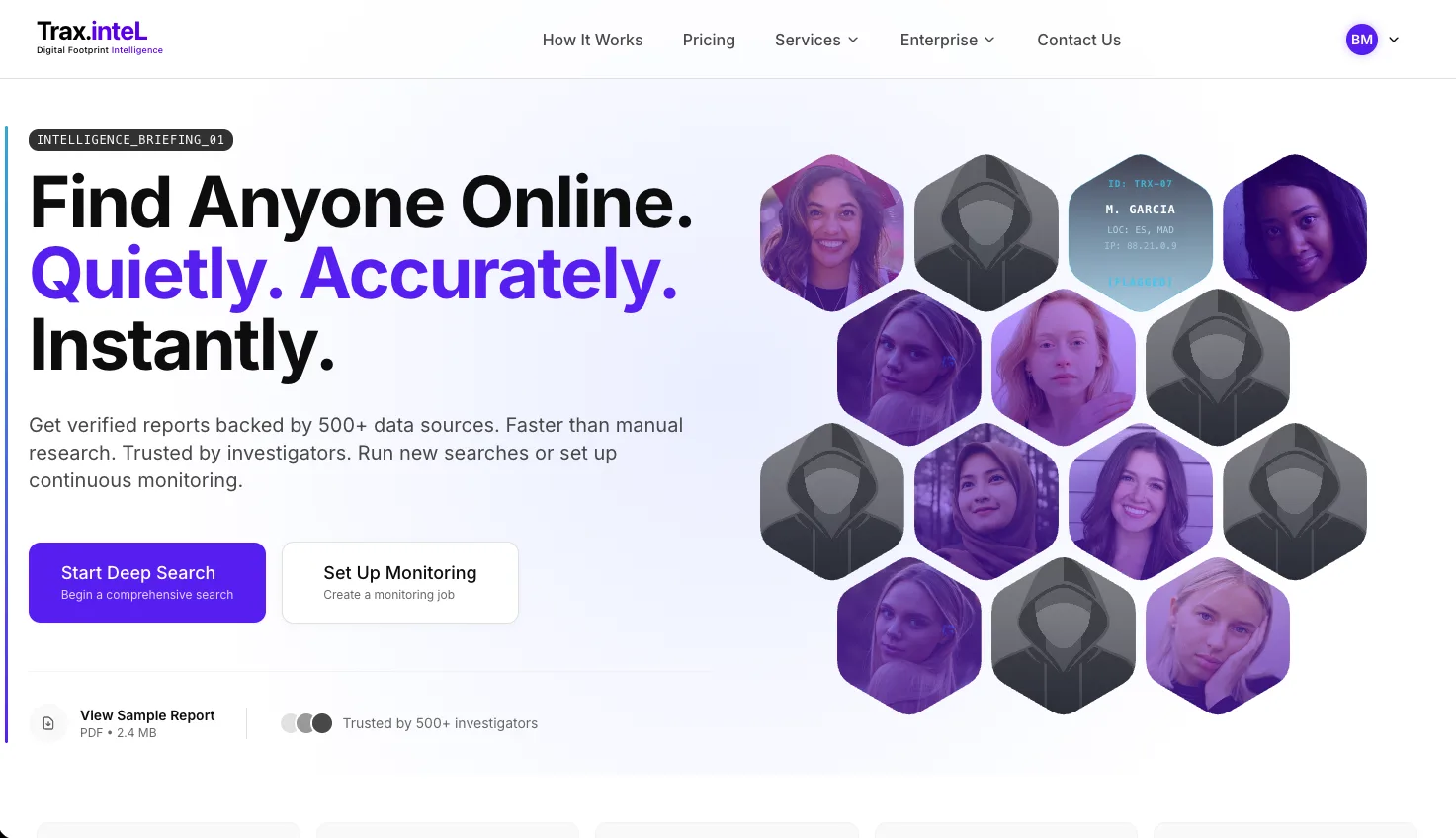 Viralink 2024 A propagation and reach analytics engine for measuring how information spreads, accelerates, and compounds across platforms.

Viralink 2024 A propagation and reach analytics engine for measuring how information spreads, accelerates, and compounds across platforms. Related writing
Solutions that use it
All solutions Due diligence Screening workflows break when identities are fragmented and review trails depend on manual search tabs. Entity resolution Raw search results stay noisy unless fragmented records can be stitched into explainable entities. Investigations workflows Case work slows down when search, enrichment, and evidence review happen in different systems. Threat intelligence Threat workflows degrade when collection, retrieval, and review are treated like separate problems.
Other capabilities
Library Collection and orchestration Browser automation, distributed workers, scheduling, and fleet-level recovery for public-data systems that need to keep working under drift. Evidence and forensics Capture pipelines, artifact integrity, provenance, and review-ready delivery for teams that need defensible outputs. Monitoring and operations Observability, alert routing, SLAs, and operator-grade feedback loops for systems that cannot fail silently.