
In the world of high-stakes automation, the primary enemy is not the CAPTCHA; it is the Telemetry Pipeline.
Modern anti-bot solutions (Akamai, Cloudflare, DataDome) don’t just check if you are “human.” They perform a deep forensic audit of your technical stack. They profile your hardware, your network stack, and your JavaScript execution environment. If they find a single inconsistency, your session is flagged, and your intelligence gathering mission is compromised.
To survive, you must move beyond “browser automation” and into Telemetry Evasion. This is not a side quest; it is core runtime work in systems like WingAgent and the broader collection and orchestration layer. This essay explores the layers of the silent arms race between automated agents and detection systems.
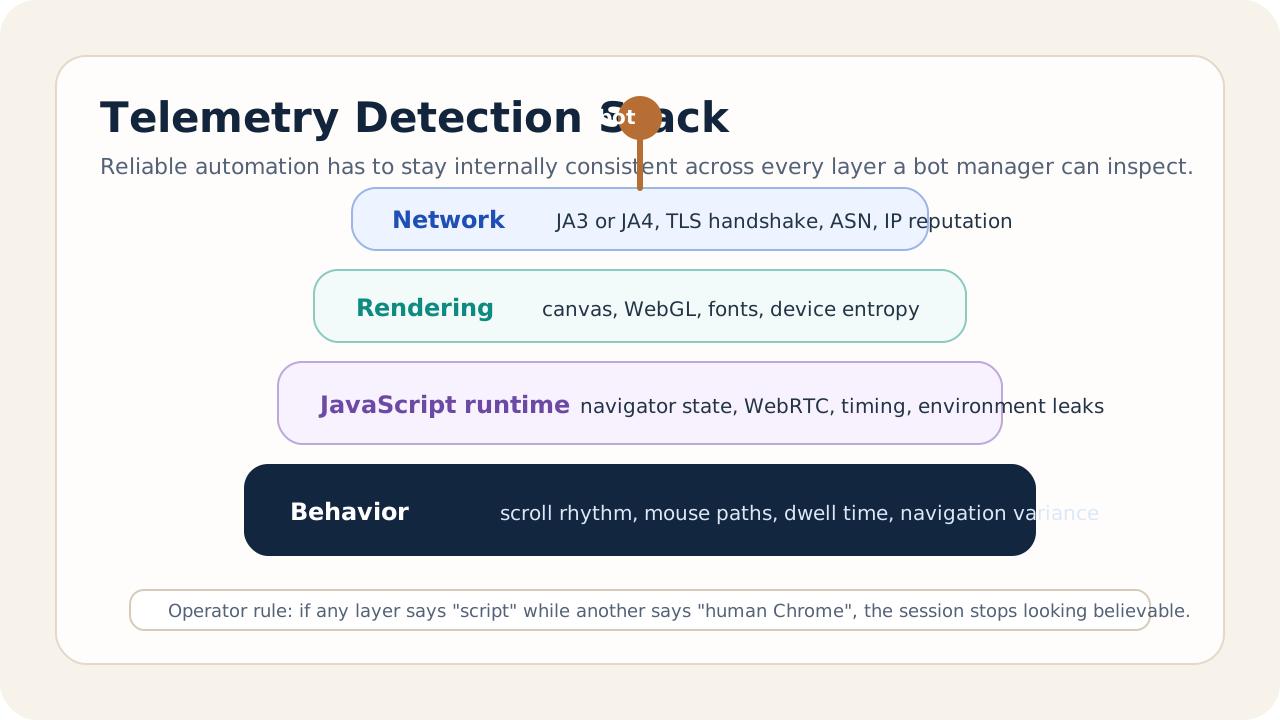
1. TLS Fingerprinting (JA3/JA4)
Detection often begins before the first byte of HTTP data is even sent. The TLS Handshake (the process of establishing an encrypted connection) reveals a unique signature of the client’s networking library.
The JA3 Metric
JA3 fingerprints look at the specific set of ciphers, extensions, and versions your client supports.
- A standard Chrome browser on macOS has a very specific JA3 fingerprint.
- A Python
requestslibrary or an unconfigured Puppeteer instance has a completely different JA3 fingerprint.
If your HTTP headers say “Chrome,” but your JA3 fingerprint says “Go-http-client,” you are immediately blocked. Resilient evasion requires TCP-Layer Mimicry—using libraries that allow you to forge the TLS handshake of a specific browser version.
Corroboration note. JA3 and JA4 are not niche research curiosities anymore. They are documented directly in the JA3 reference implementation, surfaced operationally by Cloudflare's signals intelligence tooling, and reinforced by browser-identification vendors such as Fingerprint that combine network and device signals for scoring.
2. Canvas and WebGL Poisoning
The browser’s rendering engine is a forensic goldmine. By asking the browser to draw a specific 2D shape or a 3D object (WebGL), the server can generate a “Hardware Fingerprint.”
Because every GPU and font-rasterizer renders pixels slightly differently, the resulting image hash (the Canvas Fingerprint) is unique to your hardware.
The Evasion Strategy: Controlled Poisoning
Static scrapers return the same fingerprint every time, which looks like a bot fleet. Naive evasion tools “Randomize” the pixels, which results in a “Dirty” fingerprint that looks like a bot trying to hide.
Professional evasion uses Noise Injection with Jitter. We inject a minute amount of noise into the rendering pipeline that falls within the expected variance of a real human device. We don’t hide the fingerprint; we naturalize it.
3. The JavaScript Environment: The Leakage of window
JavaScript is the developer’s window into your machine. Anti-bot scripts (like the ones from FingerprintJS) check for thousands of small “leaks”:
- Navigator Properties:
navigator.webdriveris the most famous, butnavigator.languages,navigator.plugins, and screen resolution ratios are equally important. - Micro-Timing: Measuring how long it takes to perform a specific math operation. Bots on cloud VMs often have different timing profiles than humans on laptops.
- Proxy Leakage: Checking if you are using an “Inconsistent” proxy where the Timezone or WebRTC IP doesn’t match the HTTP header IP.
Successful evasion requires Contextual Injectors that patch the JavaScript environment before any anti-bot script can execute.
4. Behavioral Jitter: The Death of the Constant
The ultimate signal is Behavior.
Humans are chaotic. We don’t scroll at 400px/sec. We don’t move our mouse in straight lines. We don’t type at 60 WPM with 0ms variance between keys.
In our TaskEngine and sensor fleets, we implement Non-Linear Behavioral Jitter:
- Trajectory Modeling: Mouse movements are modeled using Bezier curves with randomized acceleration and deceleration.
- Key-Stroke Cadence: Typing isn’t just delayed; it follows the “human rhythm” of bursts and pauses.
- Interaction Entropy: Some sessions browse for 30 seconds; some for 4 minutes. Some check three pages; some check one.
By baking entropy into the core of the interaction, we ensure that the aggregate telemetry of our fleet looks like a diverse population of users, not a single script.
Representative evasion review
When I review a failing automation session, I do not start at the selector that broke. I start by asking where the stack lost coherence:
- Did the TLS and IP reputation look like the browser we claimed to be?
- Did the JavaScript environment expose impossible combinations of
navigator, screen, timezone, or WebRTC state? - Did the rendering layer emit a fingerprint that was too static or too synthetic?
- Did the behavioral layer move with the constant cadence of a script instead of the variance of a real session?
That review pattern is why “just use Playwright stealth” is not a serious production answer. The problem is consistency, not cosmetics.

5. Summary: Defeating the Invisible
Browser Telemetry Evasion is a struggle against the invisible. It is the realization that everything your browser does is a signal.
To build a platform that survives the arms race, you must respect the deep stack. You must manage the TLS handshake, the GPU rendering, and the behavioral rhythm with the same precision you manage your data extraction.
In the high-end OSINT world, Anonymity is a Technical Achievement. It is the result of rigorous, multi-layered engineering designed to hide in the noise of a billion browsers.
Sources and corroboration
- JA3 reference implementation
- JA4 signals intelligence in Cloudflare Bot Management
- Fingerprint identification and IP-based signal handling
- WingAgent project record
Next Up: Web Forensics: Reconstructing Digital Traces After the Fact