
On the scale of Earth, the other side of the planet is only seconds away. The difficult part is getting there alive!
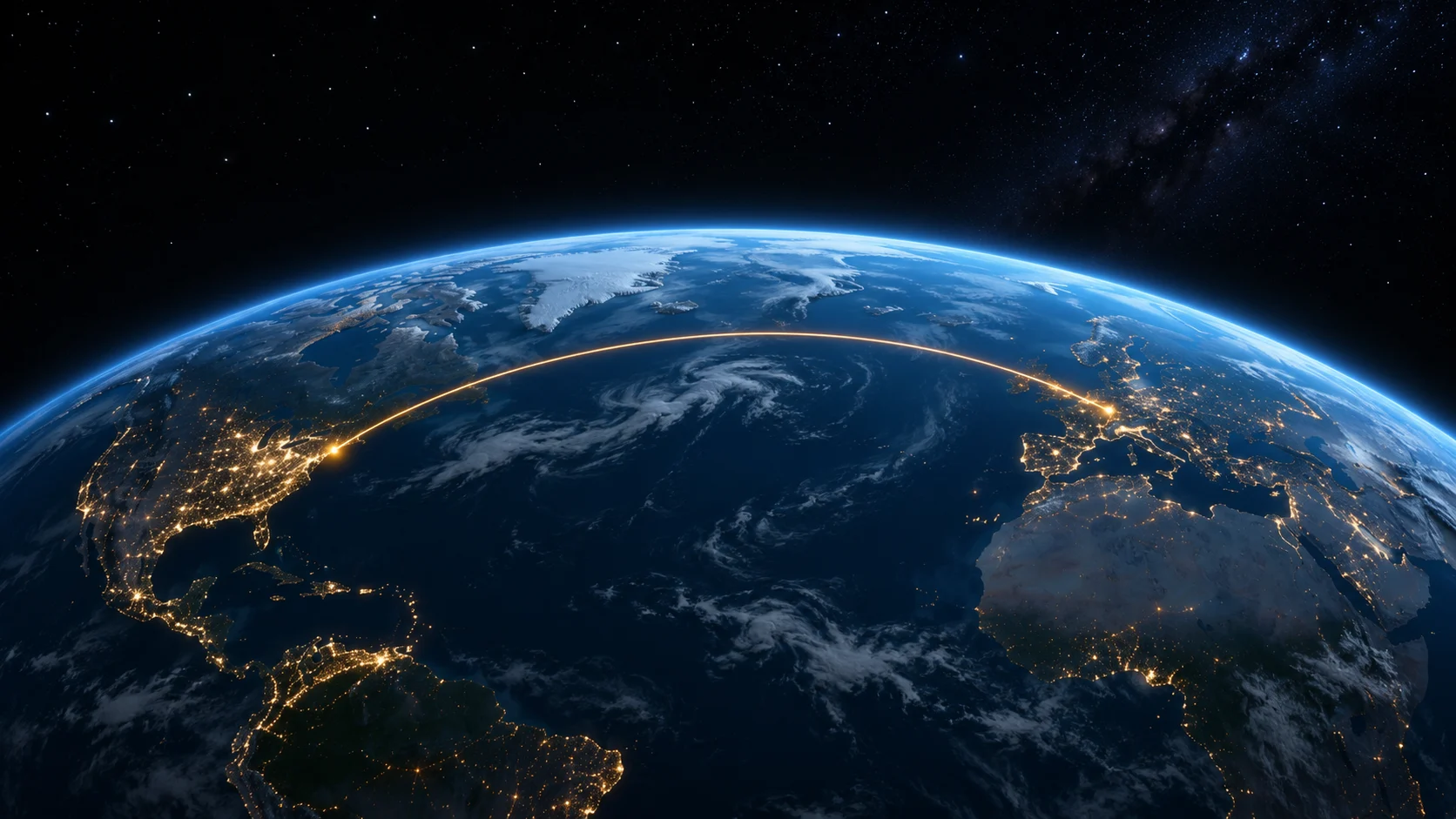
I was thinking about teleportation, and I realized that we may be asking for more than we actually need.
When people imagine teleportation, they usually imagine disappearing from one place and appearing somewhere else. No airplane. No twelve-hour journey. No losing an entire day because someone you want to see happens to live on another continent.
But most people would probably be satisfied with walking into a machine in New York and stepping out in Tokyo a few seconds later.
The journey would still exist. It would take a measurable amount of time. We would physically travel through the space between the two places.
Yet the effect on our lives could be remarkably similar to what science fiction promises.
That is the idea I find interesting: a journey does not have to take zero time for distance to stop organizing our lives.
Earth Is Small When You Travel Fast Enough
The speed of light in a vacuum is exactly 299,792,458 metres per second. One percent of that is approximately 2,998 kilometres per second.
That is already an absurd speed for a planet our size.
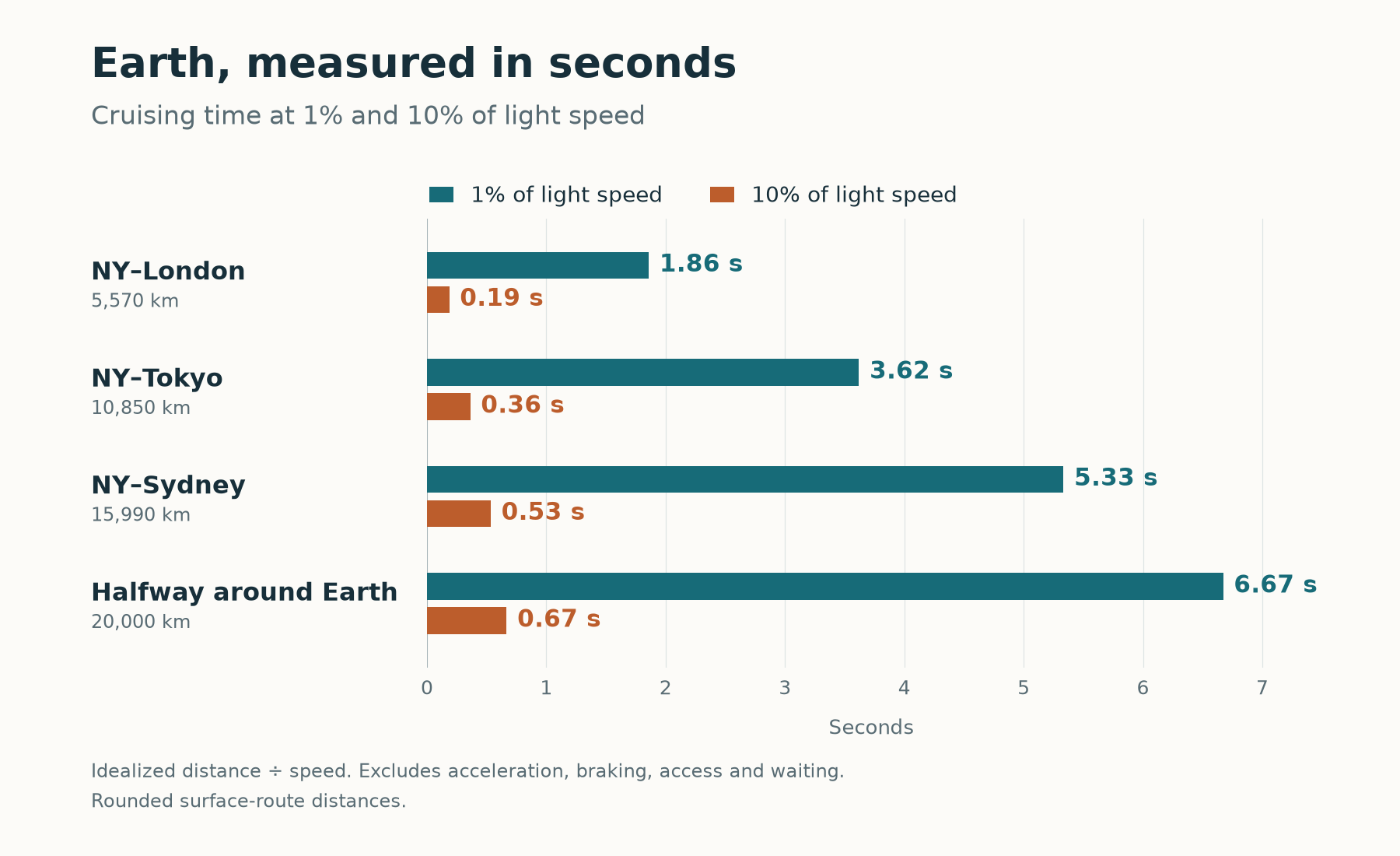
Using approximate distances along Earth’s surface, and dividing distance by speed, the cruising-time estimates at 1% of light speed are:
- New York to London: about 1.9 seconds.
- New York to Tokyo: about 3.6 seconds.
- New York to Sydney: about 5.3 seconds.
- Halfway around Earth: about 6.7 seconds.
These are deliberately simplified estimates. They assume you are already moving at that speed and exclude acceleration, braking, boarding, and everything else involved in a real journey.
At 10% of light speed, those cruising times become ten times shorter. Halfway around Earth takes about two-thirds of a second.
Six seconds is a delay you can notice. Nobody would confuse it with literally zero time. But compare it with the experience of booking a flight, packing, going to the airport, waiting, flying, and recovering from the journey.
We already wait longer than that for elevators.
If Tokyo were a few seconds away, it would occupy a completely different place in your mind. You could have lunch there and come home afterward. Seeing a friend on another continent could become an ordinary evening plan.
The map would look the same. Our relationship with it would change completely.
The Internet Has Already Changed Our Sense of Distance
The internet has already given us a version of this experience. I can send a message to someone on another continent, and it can arrive quickly enough that the distance barely enters the conversation.
Underneath that feeling, a physical journey is still taking place. Information is encoded into signals carried through cables and wireless links. Routes, transmission media, equipment, and processing introduce measurable delays. Engineers call the delay in delivering data latency.
When the delay is short enough for what we are doing, we experience the interaction as immediate. A delayed video call makes the journey obvious again. The geography was there the entire time.
The distinction between latency and throughput matters, too. The first bit of a short message and the first bit of a huge video file can follow the same route. Receiving the whole video takes longer because the connection can deliver only so much data per second.
Suppose a hypothetical payload contains N bits and a channel sends R bits per second. Merely putting those bits onto the channel takes N / R seconds. A payload of one trillion bits at one billion bits per second takes 1,000 seconds, before adding propagation and other delays.
Those are invented network numbers, not an estimate of how much information a human would require. The point is that a signal travelling quickly and an entire description arriving quickly are separate claims.
That distinction becomes unavoidable when we start drawing machines.
What My First Sketch Was Actually Asking For
I sketched two chambers joined by a transfer tube: capture and disassemble a person, transfer what is needed, then reassemble them at the other end.
Drawing it made the idea easier to discuss. It also exposed how many different assumptions I had put inside the word “transfer.”
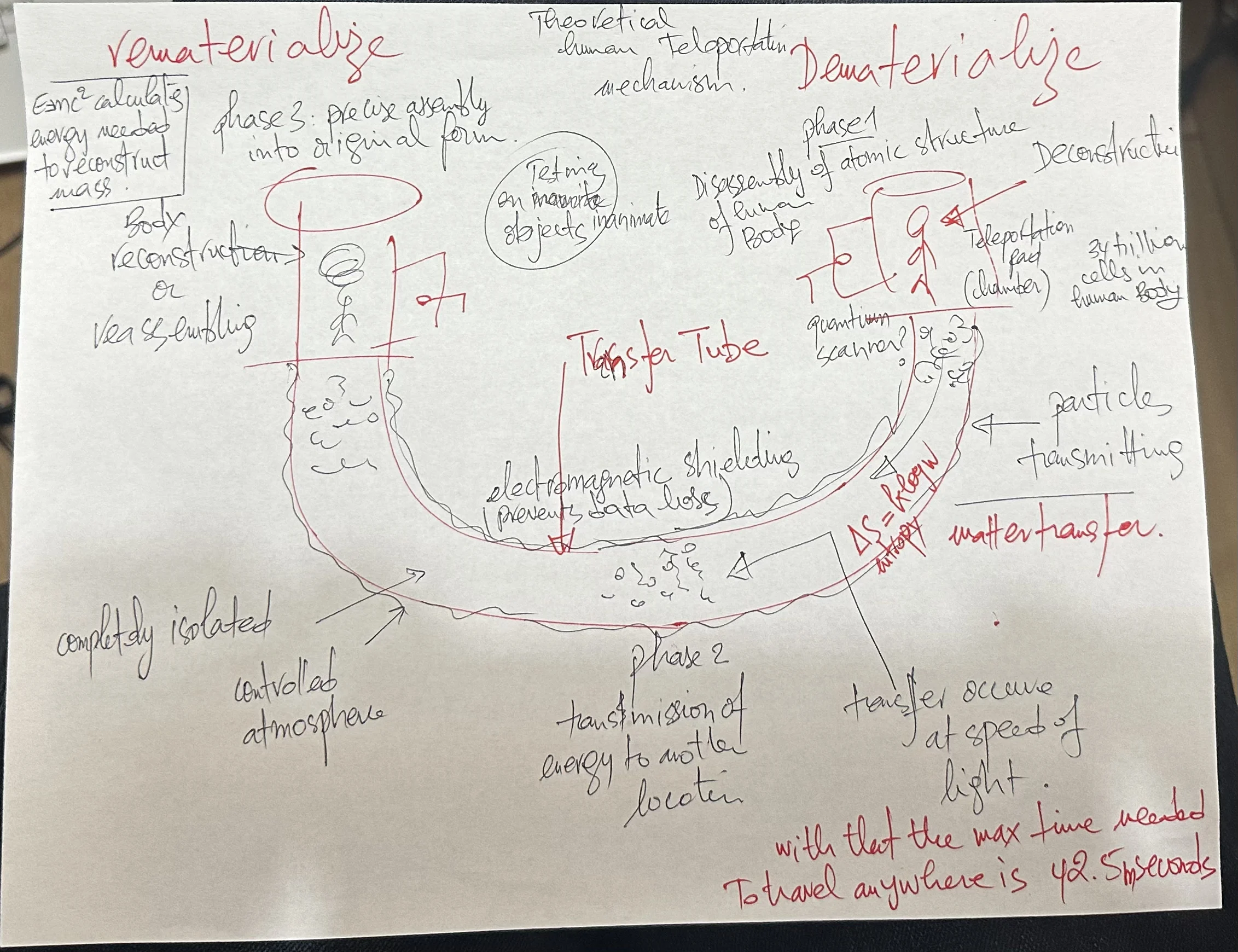
There are at least three architectures hiding in that drawing:
- Transport the original material. Disassemble it, move its constituents, and reconstruct the person using information captured beforehand. The material still has mass and travels below light speed. Disassembly and reassembly are enormous unresolved requirements.
- Convert matter into radiation and back. Now the proposal needs an actual physical conversion process and its reverse, with the necessary organization preserved. Writing “energy” on the tube does not supply either process.
- Send a description and use material already at the destination. This shifts the challenge toward measurement, communication, and biological construction. It does not require sending the original atoms, but it still needs a sufficient description and a working reconstruction method.
These ideas may look similar in a drawing. Their physical requirements are very different.
For example, E₀ = mc² tells us that the rest-energy equivalent of 80 kg is approximately 7.19 × 10¹⁸ joules. It does not tell us how to assemble a person. If the necessary atoms already exist at the destination, their entire rest energy is not automatically the energy bill for rearranging them. Mass–energy equivalence is an accounting relationship, not a biological construction algorithm. Einstein’s explanation, preserved by the American Institute of Physics, describes the underlying equivalence.
The same care is necessary with a “quantum scanner.” An arbitrary unknown quantum state cannot be converted into a complete classical description and perfectly reconstructed using that description alone. IBM’s quantum teleportation lesson explains the restriction and the different protocol that uses pre-shared entanglement plus classical communication.
But that does not establish that biological reconstruction would require every original quantum amplitude. We do not have a demonstrated human reconstruction method, or a validated specification of the information it would need. The fidelity requirement is itself an open question. A diagram cannot settle it by adding more detail to the scanner.
In the redraw below, I chose original-material transport and a separate information channel. Capture and reconstruction remain explicitly marked as unsolved. Vacuum, shielding, particle guidance, and diagnostics describe proposed functions; they do not guarantee perfect preservation.
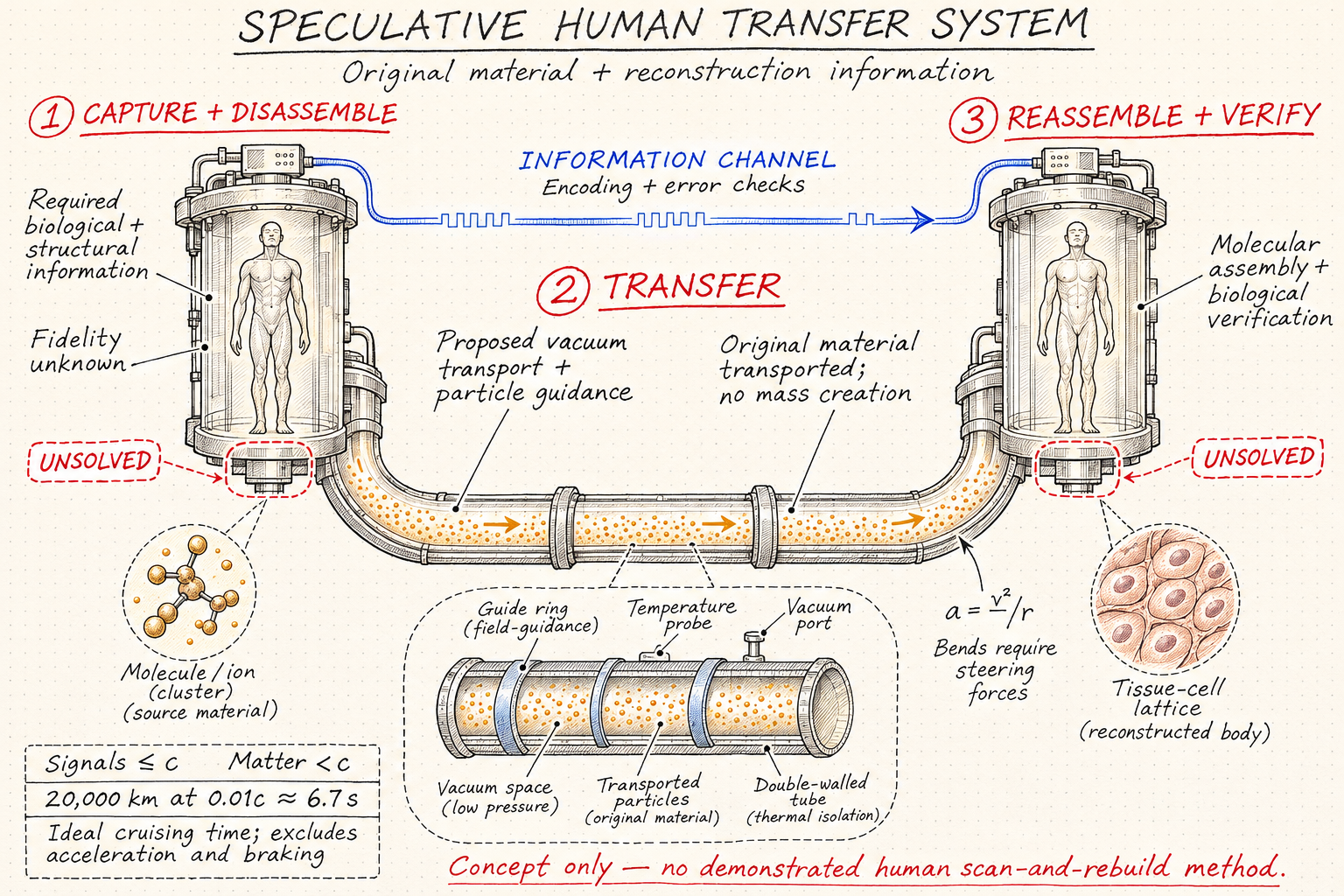
One numerical correction in the original sketch matters. Using NASA/JPL’s Earth dimensions, light takes about 42.5 milliseconds to cross the planet’s roughly 12,742 km diameter along a hypothetical straight vacuum path. Following Earth’s surface halfway around the planet takes about 66.8 milliseconds. A curved tube must use its actual length. Neither figure includes a full payload, scanning, or reconstruction.
For the high-speed travel imagined in the rest of this article, the passenger remains intact. That avoids the reconstruction question, while leaving some rather serious physics to solve.
Then You Have to Start and Stop
You begin at rest, and you would presumably like to arrive at rest.
Imagine an idealized straight journey of 20,000 kilometres. You accelerate constantly for the first half, reach 1% of light speed at the midpoint, then brake at the same rate for the second half.
The required acceleration is roughly 46,000 g.
That is around 46,000 times the acceleration associated with gravity at Earth’s surface. A human body could not survive it.
The complete trip also takes about 13.3 seconds, rather than the 6.7 seconds from dividing distance by peak speed. You spend almost the entire journey moving below that peak.
The difference is easier to see side by side:
| Idealized 20,000 km journey | Time | Acceleration assumption |
|---|---|---|
| Already cruising at 1% c | 6.67 seconds | Starting and stopping excluded |
| Start, peak at 1% c halfway, stop | 13.34 seconds | About 45,824 g each phase |
| Already cruising at 10% c | 0.667 seconds | Starting and stopping excluded |
| Start, peak at 10% c halfway, stop | About 1.33 seconds | About 4.58 million g each phase |
| Start, accelerate halfway at 1 g, stop | 47.6 minutes | Peak speed about 14 km/s |
The acceleration rows use a simplified Newtonian model with no coasting. They are comparisons of scale, not proposed routes.
The 1 g example is particularly revealing. You reach only about 0.0047% of light speed before you need to start braking. Earth runs out of distance long before the machine reaches its advertised speed.
Halfway around the planet in less than an hour would still transform civilization. It also shows how much of the problem belongs to acceleration rather than top speed.
A Vacuum Tunnel Would Still Have to Turn
The atmosphere creates another enormous problem. At thousands of kilometres per second, collisions with air would be catastrophic. An evacuated route removes much of the material in your way.
But Earth is round.
A tunnel following its surface would have to bend with the planet. Even if your speed stayed constant, your direction would keep changing. And changing direction requires acceleration.
At 1% of light speed, following a curve with Earth’s radius would require roughly 144,000 g of centripetal acceleration.
So even the middle of the journey, when the speedometer stops moving, would remain lethal for an intact passenger.
A straight tunnel creates a different problem: it goes into Earth. A route through space changes the distance and geometry, and still has to deal with departure and arrival.
We can give an imagined solution a name such as “inertial compensation.” Science fiction does that all the time. Giving it a name does not give us a mechanism. We have no known technology that lets passengers undergo these changes in velocity while remaining protected from their effects.
That missing capability is enormous.
The Energy Travels With You
There is also the energy.
Using the relativistic kinetic-energy formula, an 80 kg passenger moving at 1% of light speed carries approximately 360 trillion joules of kinetic energy.
That is about 100 gigawatt-hours.
For one person. Before adding the vehicle, propulsion system, or any losses.
That energy has to come from somewhere during acceleration, and it has to go somewhere during braking. Recovering it would be desirable. Doing so safely, repeatedly, and efficiently at this scale is another vast unsolved challenge.
At 10% of light speed, the passenger’s kinetic energy is roughly a hundred times greater. Relativity also prevents massive objects from reaching exactly light speed; additional energy cannot remove that limit.
The numbers make the travel time look easy. They make the machine look terrifying.
The Whole Journey Matters
As a software engineer, I find the distinction familiar. Making one operation extremely fast does not automatically make the whole system fast.
A vehicle that crosses an ocean in three seconds is only one part of the experience. People still have to reach it, board it, leave it, and get to wherever they actually wanted to go.
If the journey takes three seconds and the queue takes forty minutes, we have reinvented the airport.
A system that felt like teleportation would need to make the entire journey short and predictable. Stations would have to be close enough to use casually. Capacity would matter. Reliability would matter. Access would matter.
Otherwise, we would have an extraordinary machine inside a very ordinary inconvenience.
But imagine, for a moment, that those problems could be solved.
Where you live and where you work would become much less tightly connected. A hospital on another continent could become accessible in the time it currently takes to cross a neighborhood. Living far from someone would no longer necessarily mean seeing them twice a year.
Time zones would remain. Borders would remain. The political and economic consequences would be complicated.
Geography would still exist. It would simply lose much of its power over our schedules, relationships, and opportunities.
“Instant” Depends on the Size of Your World
The same speed becomes much less magical when you leave Earth.
At 1% of light speed, the Moon is about two minutes away at its average distance of roughly 384,400 km. A star a little over four light-years away is still more than four centuries away. At 10%, that interstellar trip still takes more than forty years, before accounting for acceleration and braking.
A speed that makes Earth feel tiny leaves the galaxy enormous.
I am using teleportation here to describe an imagined experience of travel. The physics would still involve motion, distance, energy, and elapsed time. Quantum teleportation is a different use of the word; it transfers quantum states and does not provide faster-than-light communication or a demonstrated way to transport a person.
And we are nowhere near being able to build the system described here.
Still, I think the distinction is useful. We often attach a dream to its most extreme possible mechanism, then assume that mechanism is the only way to get the result.
For a civilization living on Earth, the desired result may be much more specific: reach the people and places that matter without spending a significant part of your life in transit.
One percent of light speed is already enough to put the cruising time into seconds. Keeping the passengers alive and making the entire journey work are the much harder problems.
The real dream is to live on a planet where the other side no longer feels far away.
Calculation Notes
These calculations are my comparisons using the linked constants and relationships. City distances are rounded surface-route estimates: 5,570 km, 10,850 km, and 15,990 km. The long-distance example uses 20,000 km. They are not surveyed transport routes.
- Cruising:
t = d / v, withv = 0.01cor0.1c. - Accelerate halfway, brake halfway:
a = v_peak² / dandt_total = 2d / v_peak, assuming constant acceleration magnitude along a straight path and no coasting. - Limit acceleration to 1 g:
t_total = 2√(d / g)andv_peak = √(dg). Withg = 9.80665 m/s², this gives 2,856 seconds and 14.0 km/s. - Follow a curve:
a_curve = v² / r. Using an Earth radius of approximately 6,371 km gives about 144,000 g at 1% c. - Kinetic energy:
K = (γ − 1)mc², whereγ = 1 / √(1 − v²/c²). For 80 kg at 1% c, the result is approximately3.595 × 10¹⁴ J.
The acceleration models ignore route curvature, gravity along the route, propulsion limits, and changes in acceleration at the endpoints. Newtonian acceleration estimates are approximate at 10% c. The energy calculation uses the relativistic expression. No calculation here establishes a practical machine.
For more connections between science, systems, and the questions that sit between them, explore Elsewhere. More essays are in the writing archive.