
In the world of open-source intelligence (OSINT), a screenshot is often the only proof that a significant event occurred. A post is deleted, a profile is scrubbed, or a website goes offline. If you didn’t capture it correctly, that intelligence is lost forever.
But here is the engineering reality: Most “screenshot” features in intelligence tools are technically insufficient.
They treat a screenshot as an image file—a .png or a .jpg sitting in an S3 bucket. But for an investigator or an analyst presenting findings to a decision-maker, an image file is not evidence. An image file is a claim. Evidence is a claim backed by a verifiable chain of custody.
To build a professional-grade intelligence platform, you must move beyond “capturing pixels” and into Evidence Engineering. This is the same preservation logic behind WebForensicsLab, Oopsbusted, and my broader evidence and forensics work. This essay explores how to design systems that create artifacts capable of surviving scrutiny.
1. The Ephemerality of the Web
The web is a non-persistent medium. In adversarial environments, data has a half-life measured in minutes.
If your system relies on an analyst manually taking a screenshot, you have already failed. Intelligence capture must be Automated and Event-Driven. When a sensor (see Post 5) identifies a high-friction target, the system must immediately trigger a “High-Fidelity Capture” session.
This session isn’t just a screenshot. It is a full state-capture of the DOM, the network traffic (HAR files), and the rendered visual state.
2. The Chain of Custody: From Worker to Archive
A digital artifact is only as trusted as its journey. If your “Evidence” passes through three different microservices that all have write-access to the storage layer, the chain of custody is broken.
In our architecture, we implement Immutable Evidence Pipelines:
Corroboration note. This section lines up directly with formal chain-of-custody language from the NIST glossary, preservation guidance from NIST SP 800-86, and immutable storage patterns such as Amazon S3 Object Lock.
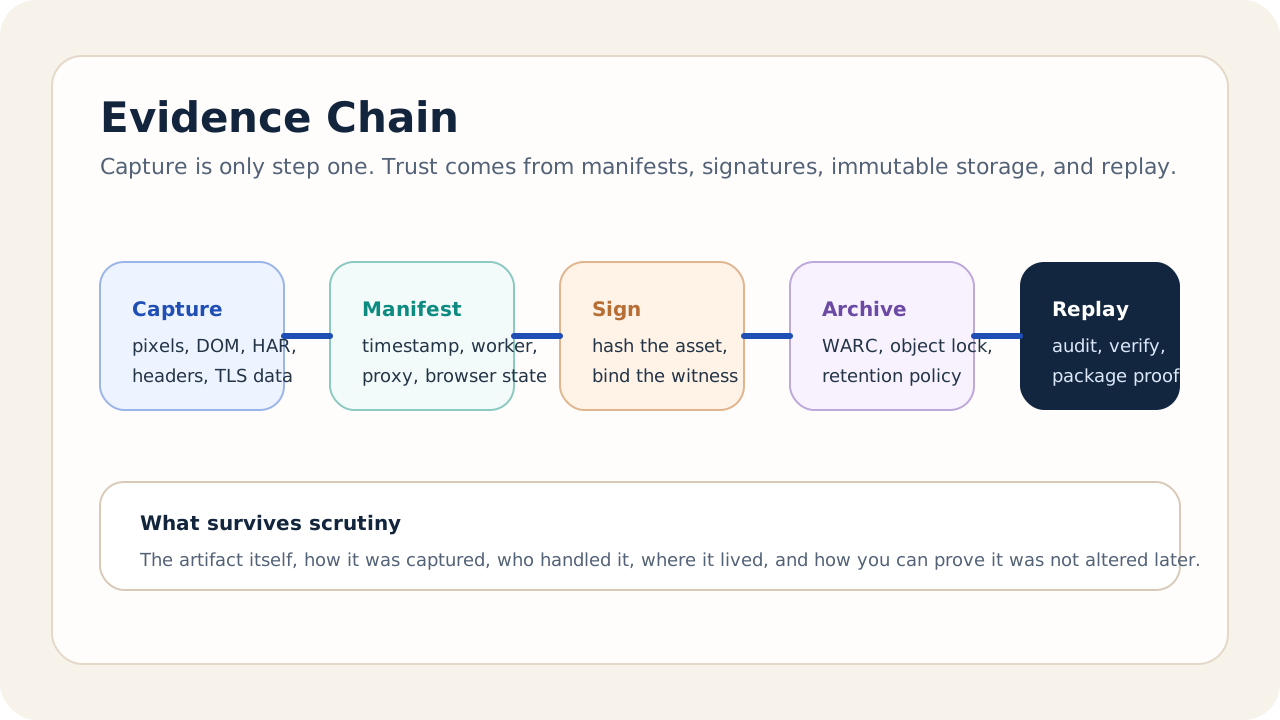
- At Capture: The worker node (e.g., our TaskEngine fleets) generates a SHA-256 hash of the screenshot the millisecond it is rendered in memory.
- Metadata Binding: We bind the screenshot to a “Capture Manifest” that includes:
- Temporal Origin: NTP-synced timestamp.
- Spatial Origin: The IP and Proxy-Exit-Node used for the capture.
- Environment Fingerprint: The specific browser version, resolution, and OS telemetry.
- Cryptographic Signing: The manifest and the hash are signed with a private key belonging to the specific worker identity.
By the time the image hits the database, it is “Wrapped” in a layer of cryptographic truth. If even a single pixel is modified later, the signature fails.
Representative capture bundle
In a representative exposure-response workflow, a single deleted post might leave the system with a bundle that contains:
- The rendered screenshot used for immediate human review.
- The DOM snapshot used for text search and later reconstruction.
- The HAR file showing which assets were loaded and in what order.
- A manifest that records worker identity, browser version, proxy exit, and timestamp.
- A cryptographic hash and signature that make later tampering detectable.
That bundle is materially more useful than “a PNG in a bucket” because every later claim can be traced back to how the page was actually seen and preserved.
3. Designing for Accountability, Not Just Identification
When an investigator presents a screenshot of a threat actor’s post, the first question from a skeptic is: “How do I know this wasn’t doctored?”
In standard engineering, we answer this with “we have logs.” In Evidence Engineering, we answer this with Verifiable Proof.
The “Signed Witness” Model
In advanced deployments, we utilize a “Witness” microservice. A secondary, independent node monitors the network traffic of the primary capture worker. It signs its own statement saying: “I saw Worker-A request URL-X and I saw the response headers match the manifest provided.”
This multi-node verification makes it mathematically impossible for a single compromised worker to “fabricate” evidence without detection.
4. Metadata as Primary Evidence
The pixels are the “What,” but the metadata is the “Why” and the “How.”
In our Intelligence Core, we treat metadata as a first-class citizen. Every screenshot is stored with its Contextual Backbone:
- DOM Snapshot: You can’t “search” an image easily, but you can search the DOM that existed at the moment the image was taken.
- TLS Fingerprints: We record the TLS certificate and handshake details of the target server. This proves we were talking to the real server and not a Man-in-the-Middle spoof.
- Network HAR: The sequence of every image, script, and CSS file requested to build that page.
This allows us to reconstruct the entire experience of the analyst, not just a static picture.

5. The Storage Paradox: Availability vs. Immutability
How do you store evidence that must be both “Fast to Query” and “Impossible to Change”?
We use a Dual-Tier Storage Strategy:
- The Active Layer: High-res versions and extracted text (via OCR) in an OpenSearch cluster for fast discovery.
- The Forensic Layer: The raw, signed WARC (Web ARChive) files and signed hashes stored on WORM (Write Once Read Many) storage.
If an investigation reaches a critical phase, the analyst can trigger a “Forensic Audit.” The system pulls the archive from the forensic layer, re-verifies the signatures, and confirms that the active layer hasn’t drifted.
6. Summary: Trust is a Technical Constraint
Evidence Engineering is the realization that in the world of intelligence, Trust is more important than Growth.
If your platform captures a million screenshots but has a broken chain of custody, you have a high-volume scraper, not an intelligence platform. By building systems that prioritize immutability, cryptographic signing, and contextual metadata, we provide operators with something better than data: we provide them with Certainty.
When an analyst says, “This happened,” the system must be able to back them up with a mathematical proof. This is the difference between a tool that “takes pictures” and a system that “secures the truth.”
Sources and corroboration
- NIST chain of custody glossary
- NIST SP 800-86: Guide to Integrating Forensic Techniques into Incident Response
- WARC implementation guidelines and ISO 28500 context
- Amazon S3 Object Lock and WORM retention
Next Up: Automation That Survives Reality: Why Most Systems Decay